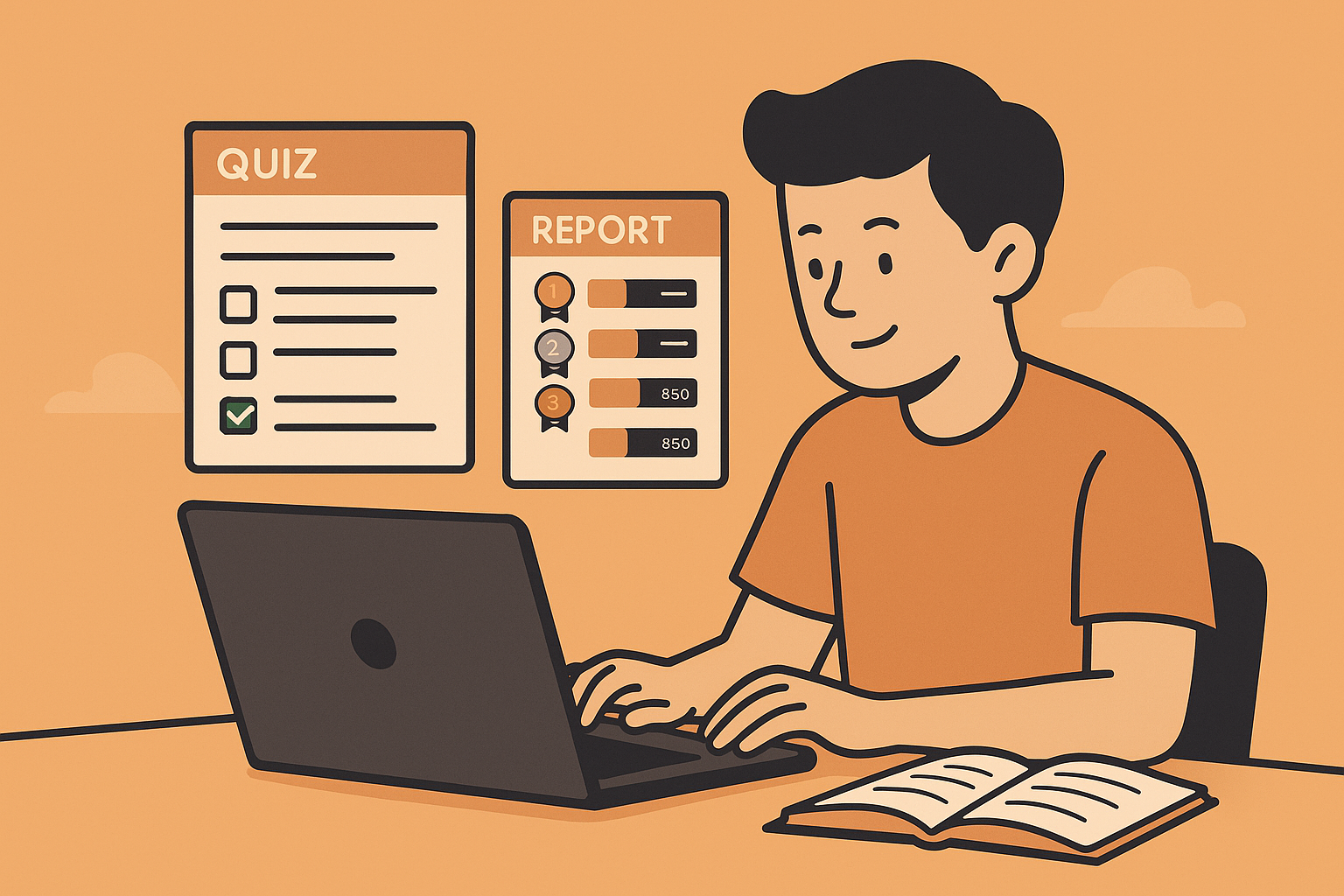
Over the past few years, online quizzes have become a familiar part of classrooms and coaching centers. Students see them as something quick and convenient, while teachers use them for revision and evaluation. But behind the convenience lies an important academic question: Do online quizzes truly make a difference in exam performance?
Research in learning science suggests that they do. When implemented properly, online quizzes contribute significantly to better memory, stronger understanding, and improved exam confidence. Their effectiveness does not come from technology alone but from the way quizzes reshape how students engage with information.
A More Effective Form of Recall
One of the most influential discoveries in cognitive psychology is that the act of recalling information strengthens memory more than simply rereading it. This process—known as active recall—is the foundation of effective study habits.
Online quizzes rely on this principle. When a student attempts a question, the brain is required to retrieve the answer instead of passively recognizing it from text. This mental effort reinforces the memory in a way that traditional revision methods often fail to achieve. In a study conducted at Washington University, students who practiced retrieval through quizzes performed substantially better on final exams than those who relied primarily on reading and highlighting.
Online quizzes essentially transform revision into a thinking exercise rather than a reading exercise, and this distinction matters.
Immediate Correction and the Value of Timely Feedback
A common problem during exam preparation is that students do not always know whether they understand a concept correctly. Mistakes may go unnoticed, only to reappear in the exam hall.
Online quizzes interrupt this cycle by providing instant feedback. As soon as an answer is submitted, the student sees not only whether the response was correct but also why. Explanations, diagrams, and examples reinforce the concept at the moment when the student is most attentive. Research from Stanford University shows that immediate feedback leads to deeper conceptual understanding and fewer repeated errors.
In subjects like mathematics and grammar—where misunderstandings are easy to develop and difficult to unlearn—this timely correction is especially valuable.
Reduced Exam Anxiety Through Familiarity
A significant portion of exam stress comes not from the content itself but from the conditions under which it is tested. Timers, unfamiliar formats, and the pressure of accuracy create an emotional barrier for many students.
Online quizzes simulate these conditions in a low-risk environment. Timed questions encourage students to think efficiently. Mixed levels of difficulty prepare them for unpredictability. The overall structure mirrors the pattern of school and board exam formats. As a result, students gradually become more comfortable with the pressure, and the actual exam feels familiar rather than intimidating.
The psychological effect is simple: familiarity reduces anxiety, and reduced anxiety often leads to better performance.
Repetition That Builds Long-Term Learning
Students often assume that long study hours automatically lead to better marks. In reality, spaced repetition—reviewing information periodically over time—is far more effective than prolonged cramming.
Online quizzes naturally support this method. Students can revisit the same quiz multiple times or encounter similar questions across different sessions. Each encounter reinforces previous learning and pushes information deeper into long-term memory. Studies from the University of California suggest that spaced repetition significantly improves retention, particularly for subjects that require memorization.
This is one of the reasons students who regularly practice quizzes tend to remember more during exams.
Insights That Help Students and Teachers Focus Their Efforts
Another important advantage of online quizzes is the data they generate. Students can clearly see which topics they struggle with, where they are losing time, and how their accuracy changes over multiple attempts. Instead of guessing what to revise, they have concrete evidence of where improvement is needed.
Teachers benefit from these insights as well. Quiz reports reveal common problem areas across an entire class, helping instructors devote additional time to concepts that genuinely require clarification. Learning becomes more efficient and targeted.
Motivation, Engagement, and the Habit of Consistency
Although rarely discussed, motivation plays a meaningful role in exam preparation. Students tend to stay more consistent when learning feels interactive and challenging. Online quizzes introduce an element of engagement—progress tracking, challenge, and variety—that traditional revision methods lack.
This does not mean quizzes replace textbooks or classroom explanations, but they encourage students to practice more frequently. Over time, this consistency turns into better performance.
A Complement, Not a Replacement
Online quizzes are most effective when they work alongside other study methods. They reinforce concepts learned in class, clarify doubts through explanations, and strengthen memory through regular retrieval. They should be seen as an extension of learning rather than an alternative to it.
The combination of classroom teaching, textbook learning, written practice, and online quizzing creates a balanced preparation strategy that addresses both understanding and recall.
You should read also – Pro Tips to Use Quizizz Like a Pro in 2025
Conclusion
The evidence is clear: online quizzes do help students prepare more effectively for school exams. They strengthen memory through active recall, correct mistakes at the right moment, reduce exam anxiety by familiarizing students with testing patterns, and support long-term retention through repeated practice. They also offer valuable insights into learning progress for both students and teachers.